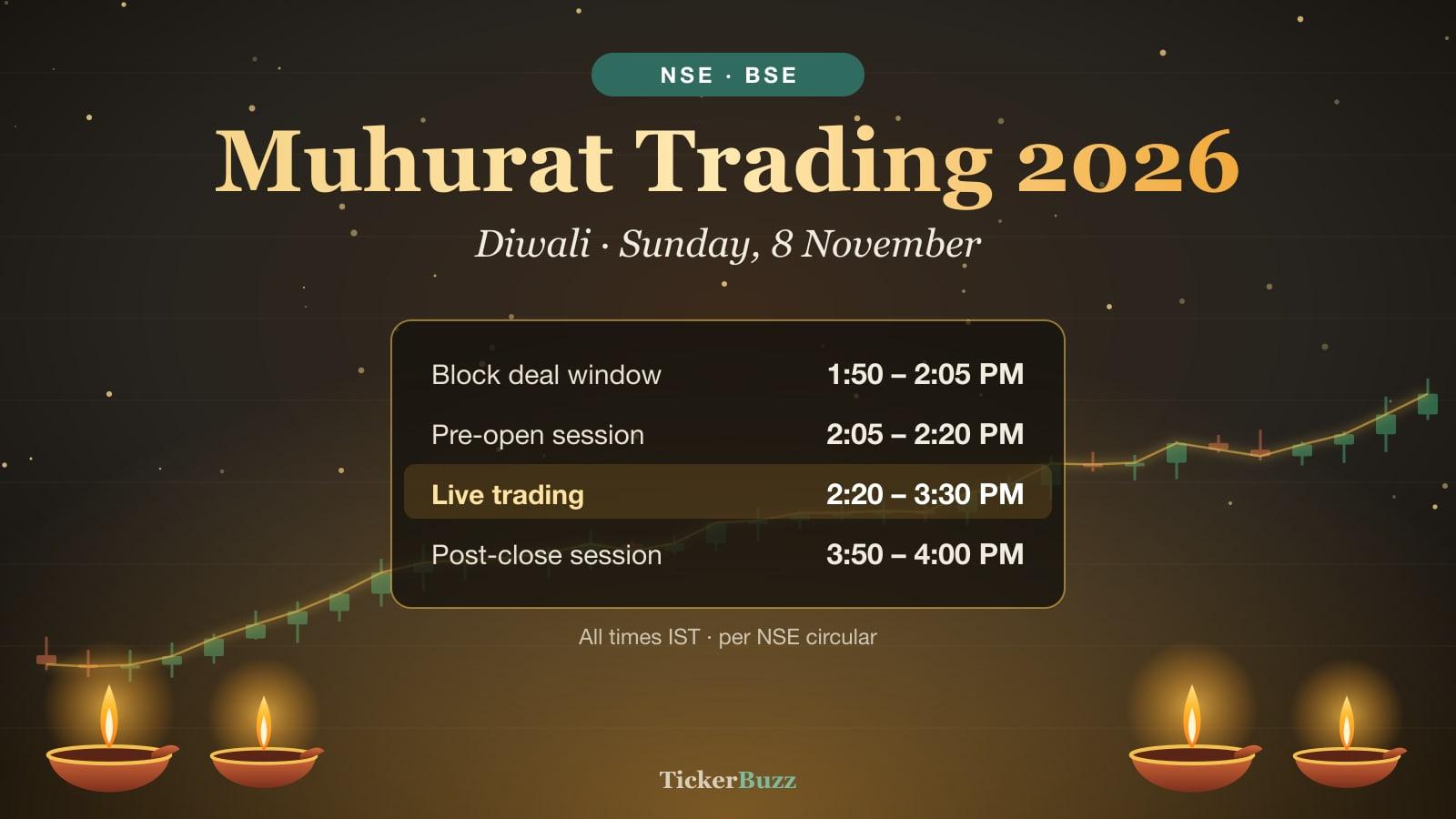
Indian stock markets will open on a Sunday this week for the annual Diwali Muhurat trading session. NSE and BSE will hold the special session on Sunday, 8 November 2026, the day of Diwali Laxmi Pujan. Live trading runs from 2:20 PM to 3:30 PM IST, preceded by a 15-minute pre-open session from 2:05 PM.
Muhurat trading 2026 timings
The schedule below is from NSE's circular for the capital market segment (NSE/CMTR/76941, dated 19 October 2026). All times are IST.
| Session | Start | End |
|---|---|---|
| Block deal window | 1:50 PM | 2:05 PM |
| Pre-open: order entry | 2:05 PM | 2:15 PM |
| Pre-open: order matching and trade confirmation | 2:15 PM | 2:17 PM |
| Pre-open: buffer period | 2:17 PM | 2:20 PM |
| Normal market (live trading) | 2:20 PM | 3:30 PM |
| Closing auction session (order entry) | 3:20 PM | 3:30 PM |
| Post-close session | 3:50 PM | 4:00 PM |
| Trade modification cut-off | 2:20 PM | 4:15 PM |
Two details from the circular are worth knowing:
- Pre-open order entry closes at a random moment in its last two minutes (between 2:13 PM and 2:15 PM). From 2:10 PM, market orders can no longer be modified or cancelled; only limit orders can.
- For stocks in the closing auction session, continuous trading ends at 3:15 PM rather than 3:30 PM, followed by the closing auction.
What is Muhurat trading?
"Muhurat" means an auspicious time. In Hindu tradition Diwali marks the start of a new financial year, and many traders and business families open new account books (chopda pujan) on Laxmi Pujan. The stock exchanges mark the occasion with a short trading session, usually lasting about an hour. Many investors use it to make a token purchase for the new year.
The session also marks the start of a new Samvat, the Hindu calendar year. The 2026 session ushers in Samvat 2083.
It is a real trading session
Muhurat trading is ceremonial in spirit but not in practice. NSE's circular states plainly that all trades executed in the session will result in settlement obligations, exactly like a normal trading day. Shares bought will be delivered and must be paid for, and intraday and F&O positions carry the same margin rules as any other session.
What traders should keep in mind
- Volumes are usually thin. Many institutions participate lightly in the hour-long session, so a small number of orders can move prices. Bid-ask spreads in less liquid stocks can widen.
- Use limit orders. With low liquidity, a market order can fill at an unexpectedly poor price. A limit order caps what you pay.
- Don't read too much into the move. A single hour of festive trading says little about where markets go in the year ahead. Treat any symbolic purchase as a long-term investment decision made on fundamentals, not on the date.
- Check your broker's timings. Brokers may set their own order-entry windows and square-off times for intraday positions during the session.
The trading week around Diwali
| Date | Market status |
|---|---|
| Sunday, 8 November | Open for the Muhurat session only (2:20 PM–3:30 PM) |
| Monday, 9 November | Normal trading |
| Tuesday, 10 November | Closed for Diwali-Balipratipada |
| Wednesday, 11 November | Normal trading |
The holiday on 10 November also affects the IPO timetable. Vedant Poly Fabs lists on NSE SME on Monday 9 November and Antala Industries on BSE SME on Wednesday 11 November; see our IPO calendar note for Diwali week. The next exchange holiday after that is Tuesday 24 November for Guru Nanak Jayanti. The full list is on our market holidays 2026 page.
TickerBuzz wishes all our readers a happy and prosperous Diwali and Samvat 2083.
This article is for information only and is not investment advice. Session timings are taken from NSE's official circular; brokers may apply their own cut-off times. Consult a SEBI-registered investment adviser before investing.


